Notre Mission
HauLakota is a project I created to help, in my own way, preserve the Lakota language and culture. While the site is primarily focused on French translation, an English translation is available on the site so that everyone can learn or find information about this endangered language. My name is Sacha R "Mató Ȟótah", I created this project at 21 years old, and I am French with Lakota origins.
If you wish to contact me for any reason, the project's email address is haulakota@gmail.com
The "Posts" section is used to share information and articles about Lakota culture. As for the "Groups" section, it allows for conversation on Native American culture topics, like a forum.
The Instagram account will share information about the Lakota nation and also word translations from time to time.
Lakhóta iyápi héčhaŋ!

Histoire et Origines
Lakota, one of the languages of the great Sioux nation, carries within it the memory of the Great Plains. Transmitted from generation to generation through speech, songs, and stories, it tells of a deep connection with the land, the seasons, and the elders. The term "Lakota" also refers to the tribe of the same name. Our site therefore refers to the language (for the dictionary, for example), but also to the Siouan tribe (for the representation and archiving of its culture, for example).
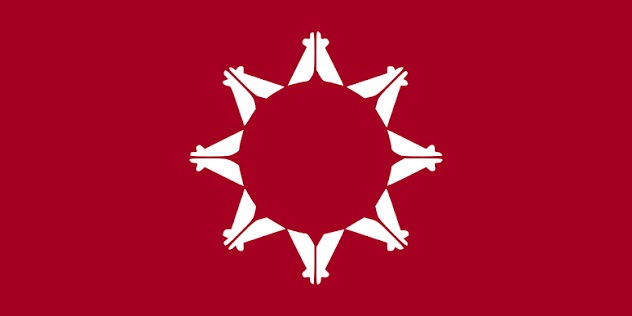
Our mission is to preserve and share this living language. By offering resources accessible to all, we wish to honor this heritage and help everyone make Lakota words resonate in the present and the future. We display the Oglala flag, which perfectly represents our values:
-
The red background symbolizes the blood shed by members of the tribe to defend their lands, as well as a reference to the allegorical term "Red Man" once used by Americans of European descent.
-
The circle of white tipis represents unity and the traditional layout of the Native American encampment (hocoka). The white tipis symbolize the different districts of the reservation (such as Pine Ridge, Wounded Knee, Porcupine, etc.). And the circular shape is always very present in Native American culture.
Les Lakotas sont traditionnellement divisés en sept sous-groupes principaux :
-
Oglalas
-
Hunkpapas
-
Brûlés (Sicangu)
-
Miniconjous (Minneconjou)
-
Sans-Arcs (Itazipco)
-
Sihasapas (Pieds-Noirs)
-
Two Kettles (Oohanunpa)
The Lakota language has had a written form since 1840 and is taught in primary and middle schools on the reservations of South Dakota. Since 1982, a standard alphabet was developed and adopted in the 2008 New Lakota Dictionary. It is this alphabet that is used on the HauLakota.org site, allowing for the pooling of different sources and the use of a recent and unified alphabet.
The Heritage for the Future
Every Lakota word carries the memory of a people, their worldview, and their deep connection to the land. Access to language education should be simpler than the current state of affairs. We can commit ourselves to not letting a living language and the culture it carries die.
Commitment
HauLakota contributes in its own way by creating online spaces for discovery, transmission, and sharing around the Lakota language and culture. Through groups, an Instagram account, and potentially future gatherings, we invite everyone to learn, exchange, and participate in the preservation of this living heritage. These initiatives bring generations closer together and encourage an engaged, open, and respectful community that honors traditions.
We encourage the AIM (American Indian Movement) and have been providing our support from France to this movement, which defends the civil rights of Native Americans.
Dictionary sources
Notre dictionnaire Lakota–Français est un projet indépendant de documentation et de transmission linguistique.
Les traductions sont recherchées, comparées et vérifiées à partir de différentes ressources linguistiques.
Ouvrages de référence
-
Jan Ullrich, New Lakota Dictionary, Lakota Language Consortium.
-
Dictionnaires et ouvrages universitaires spécialisés dans la langue lakota.
-
Slim Batteux, Je parle Sioux - Lakota - Grammaire sioux / français.
Ressources numériques
-
Lakota Language Consortium.
-
Ressources pédagogiques et publications linguistiques accessibles en ligne, telles que :
-
Red Cloud Indian School Conversation Basics
-
https://www.arizona-dream.com/usa/amerindiens/articles/mots-amerindien.php
-
Middle School Lakota Language Bowl Vocabulary Packet
-
https://desmotsetdeslangues.eklablog.com/lakota-a115124720
-
https://fr.wiktionary.org/wiki/Annexe:Lexique_Lakota-Fran%C3%A7ais
-
https://wolf-eyes.forumactif.com/t1354-dictionnaire-francais-lakota
-
https://itancansioux.wordpress.com/2008/10/17/lexique-francaissioux-lakota/
-
https://www.fnac.com/a178662/Joseph-Epes-Brown-Les-Rites-secrets-des-Indiens-Sioux
-
https://www.arizona-dream.com/usa/forum-usa-amerindien/t281-traduire-phrase-lakota-francais.php
-
https://amerindiens-thewest.forumactif.org/t35-lexique-francais-lakota
-
Lakota Dictionary: Lakota-English / English-Lakota
-
https://drumhop.com/Images/lakotalanguage/Lesson1.pdf
-
https://dakotaplants.wordpress.com/2018/05/12/p%C8%9Fan%C7%A7i/
Méthodologie
Each entry is subject to documentary research. Spelling variants and alternative translations are kept when attested.
This dictionary is an independent project and is not affiliated with the organizations whose publications are used as references.